Back To Blog


Key Takeaways
- Regular commercial truck alignments reduce operating costs by extending tire life, improving fuel economy and minimizing wear on critical components.
- Proper wheel alignment improves vehicle handling and safety by helping trucks track straight and reducing driver fatigue.
- Scheduling alignments as part of preventive maintenance helps catch small issues early and avoid costly repairs and downtime.
Ever notice your truck drifting toward the shoulder even when your hands are dead center on the wheel? Or maybe you’ve noticed your tires wearing down on one edge way faster than the other. In many cases, your truck is telling you it needs an alignment.
Alignments are one of the maintenance items that are easy to put off until it becomes a bigger issue. However, if there's one thing 60 years of servicing commercial trucks has taught us, it's that a commercial truck alignment pays for itself many times over. It protects your tires, your fuel budget and your safety record.
In this guide, we'll explain what a commercial truck alignment is, why it matters, the warning signs to watch for and when to schedule one.
What Is a Commercial Truck Alignment?
A commercial truck alignment adjusts your truck's suspension and steering components so that every wheel sits at the correct angle, both relative to each other and to the road.
The tires themselves aren't the focus. What matters are the angles that control how those tires meet the pavement. Getting each angle correct is what keeps vehicle tires rolling straight and wearing evenly.
What Technicians Adjust During an Alignment
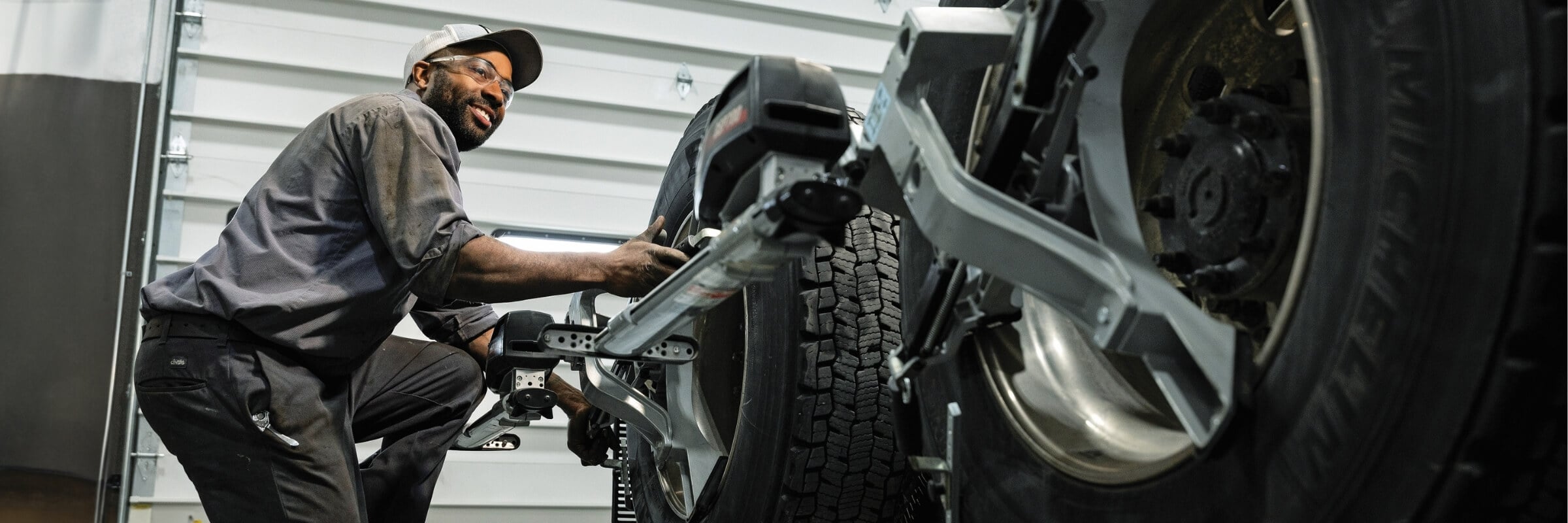
Technicians use specialized equipment to measure the exact angle at every wheel position, then adjust suspension components (tie rods, cam bushings, shims, etc.) until everything falls within the manufacturer's spec.
This includes checking ride height, inspecting for worn suspension or steering components, and verifying there isn't frame or suspension damage preventing the truck from being aligned to manufacturer specifications.
Steer Axle Alignment vs. Drive Axle Alignment
Every truck alignment needs to account for how the steer axle and drive axle work together.
- Steer axle alignment covers the front axle (the one doing the actual steering) and gets the most attention because it has the biggest effect on handling and tire wear.
- Drive axle alignment covers the powered rear axle or tandem drive axles that deliver engine torque to the road.
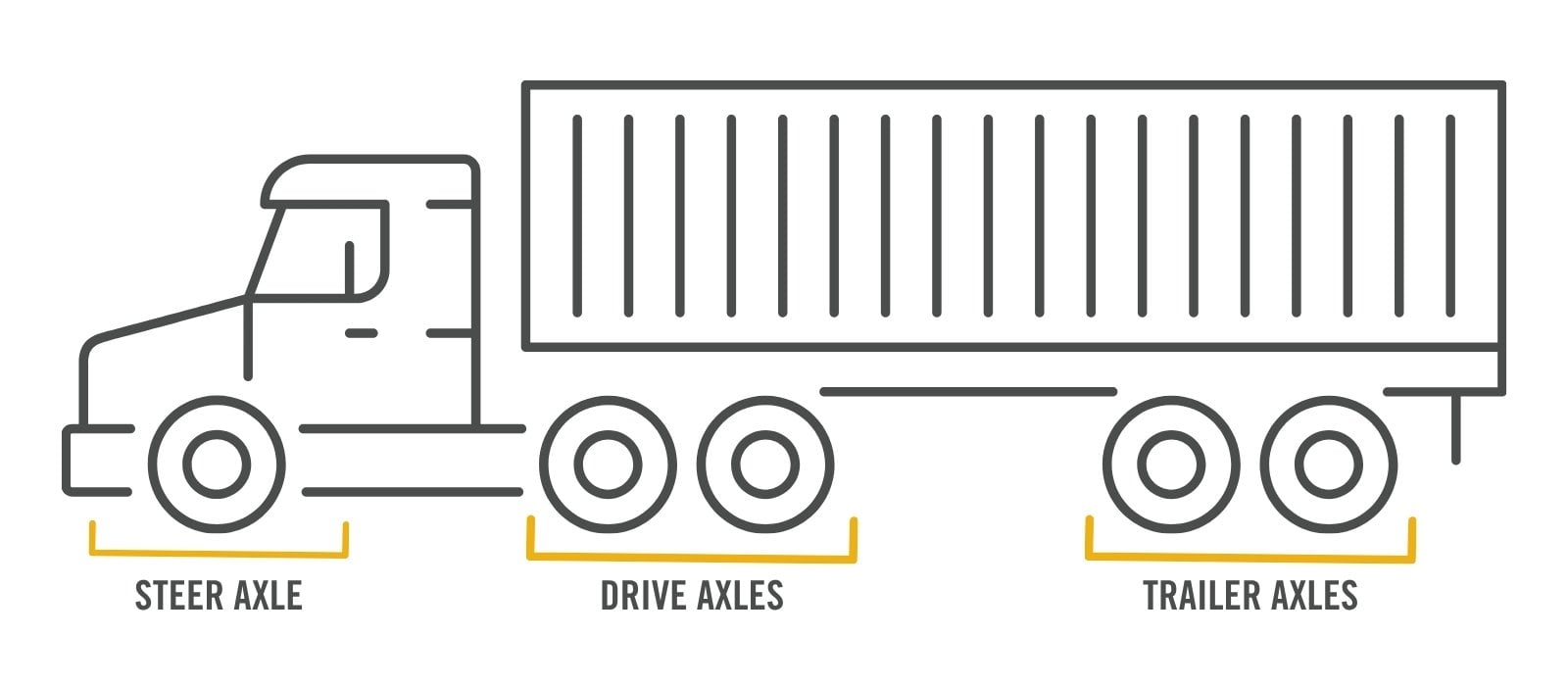
When the drive axle sits out of line with the steer axle, you can end up with a thrust angle problem, where the rear axle nudges the truck slightly sideways even though you're driving completely straight.
Trailer axles also need to be checked, especially if you're pulling the same trailer over uneven roads for thousands of miles at a time. A misaligned trailer can create drag, accelerate tire wear and reduce fuel economy even if the tractor itself is properly aligned.
A true truck suspension alignment should involve looking at the tractor and trailer as one connected system. Once every axle is square with the others, it comes down to the individual angles at each wheel.
Common Alignment Angles: Camber, Caster and Toe
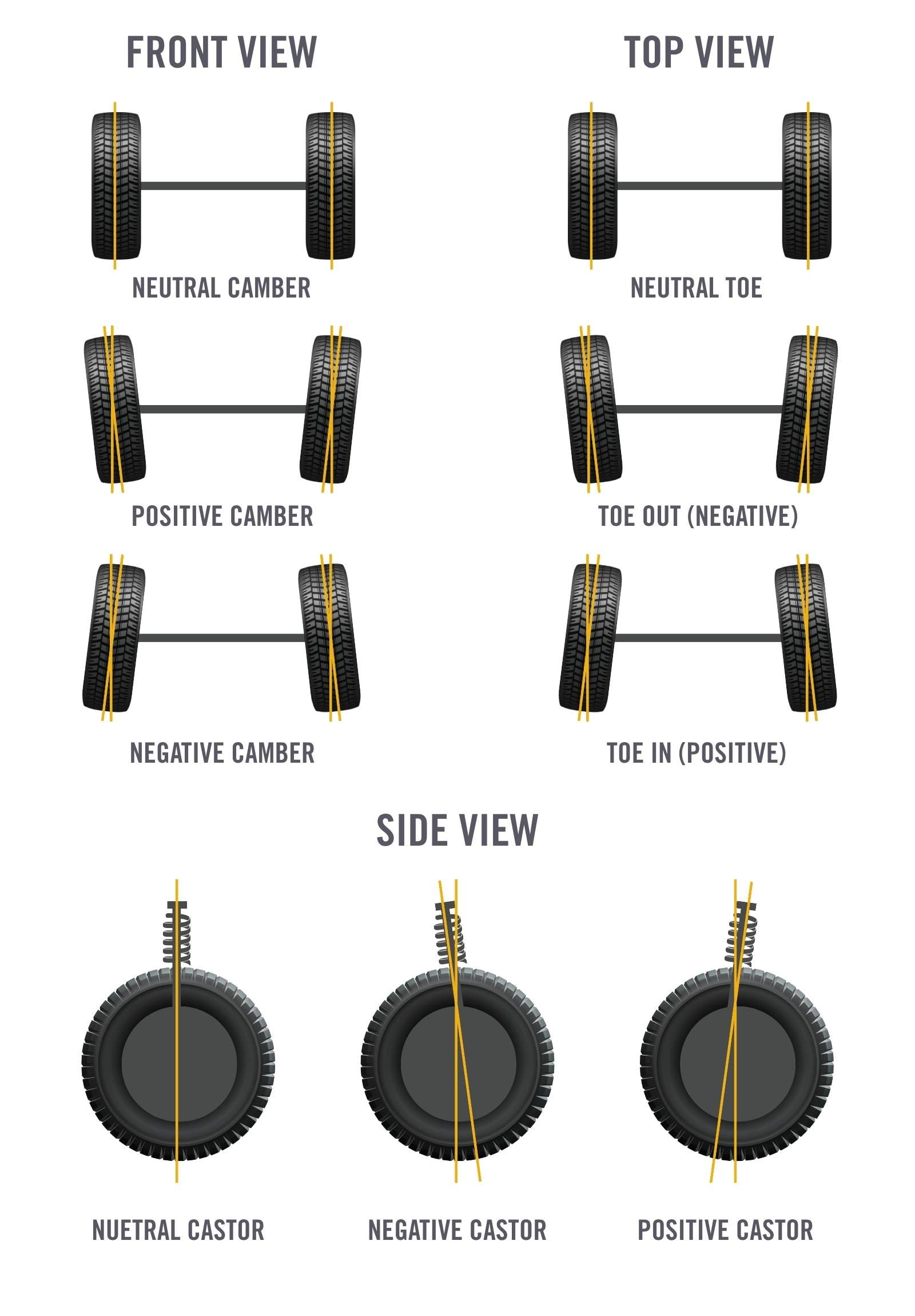
Three angles do most of the work in any wheel alignment for trucks:
- Camber is the inward or outward tilt of the tire viewed from the front. Too much camber in either direction wears down one edge of the tread more quickly.
- Caster is the forward or backward tilt of the steering axis, viewed from the side. This is what keeps your steering wheel centered and your truck tracking straight without constant correction.
- Toe is whether the front of the tires points slightly in or out compared to the back. Even a small toe misalignment drags the tire sideways with every rotation, wearing down tread quickly.
Getting all three angles dialed in through a proper tire alignment helps a truck drive the way it was engineered to, without you having to fight the wheel.
Why Proper Truck Wheel Alignment Matters
If you skip alignment checks long enough, a subtle pull to one side can turn into extra tire wear, higher fuel costs and safety issues.
Below are some of the reasons regular and proper truck alignments are important, beyond just ensuring a smoother ride.
Tire Life
Tires are one of the largest recurring costs for any fleet or owner-operator, and a misaligned vehicle is one of the fastest ways to cause premature tire wear.
Even a minor toe misalignment causes irregular tire wear. Instead of rolling straight, the tire scrubs sideways against the road with every rotation. This wears down tread far faster than normal, and it can cut a tire's usable life short by tens of thousands of miles. Multiply that across six or more tires, and a bad alignment can turn into a serious replacement bill.
Keeping up with tire alignment protects tire longevity and gets you the full mileage you paid for.
Fuel Economy
Keeping tires properly inflated and aligned is one of the simplest ways to protect fuel efficiency. Misaligned wheels create extra rolling resistance, which means the engine works harder just to hold a steady speed.
For a truck logging hundreds of miles a day, that inefficiency chips away at your fuel mileage, and it adds up over a year of driving.
Safety
A misaligned steering axle can make the truck slower to respond to steering inputs during emergency maneuvers. Steering wheel vibration at highway speed is often the first warning sign, which usually means you’re fighting the wheel instead of reacting to traffic, weather or a sudden lane change. That constant correction can contribute to driver fatigue over a longer route.
Federal regulations require carriers to keep steering and suspension systems in safe operating condition at all times. A truck that won't track straight is a truck that's harder to control when it counts.
Reduced Wear on Suspension, Steering, Wheel Bearings and Axles
Alignment problems don’t stay isolated to the tires. A truck running out of spec puts extra stress on tie rod ends, steering components, bushings and wheel bearings, all of which are expensive to replace.
That strain wears down the performance of heavy-duty equipment faster than it should. Left unchecked, it can throw off axle positioning, too.
Signs Your Commercial Truck Needs an Alignment
Most alignment problems announce themselves pretty clearly if you're paying attention during your pre-trip inspection or while you're out on the road. Watch out for the following signs:
- Your truck pulls to one side when driving – even on a flat, straight road
- The steering wheel sits crooked when you're driving straight ahead
- Uneven tire wear, especially on the inside or outside edge of the tread
- Feathering on the tread, where the rubber feels sharp on one side and smooth on the other
- Steering wheel vibration or cab shake at highway speeds
- Poor handling or a wandering feeling on the interstate
- Constant small steering corrections just to hold your lane
- Fuel economy that's dropped with no obvious explanation
Catch any one of these signs early, and a quick heavy-duty truck alignment can usually fix it before it turns into a bigger repair bill.
When Should You Get a Commercial Truck Alignment?
Alignment isn't just a reactive fix. Many fleets inspect alignment at regular preventive maintenance intervals, with frequency depending on duty cycle, road conditions and manufacturer recommendations.
Building it into your regular maintenance routine, alongside your other preventive maintenance, keeps small issues from snowballing.
Here's when to schedule a truck alignment service:
- After installing new tires (a bad alignment will wear down fresh tread just as fast as the old set)
- After a new truck's break-in period, once the frame and components have had time to settle
- Following any suspension repair or component replacement
- After steering system repairs
- Anytime you've hit a curb, pothole or other significant road hazard
- After an accident, even a minor one
- When you notice abnormal or uneven tire wear
- As a standard part of your preventive maintenance schedule
Schedule Your Commercial Truck Alignment at Rush Truck Centers
A commercial truck alignment is one of those jobs that's easy to overlook until it costs you in tires, fuel or downtime. Including it in your preventive maintenance routine protects your investment and delivers benefits beyond a smoother ride, keeping your truck and your drivers safer on the road.
Rush Truck Centers offers same-day Xpress Alignment services at locations nationwide. Our system delivers accurate wheel alignment and balancing measurements, helping you improve handling, boost fuel economy, maximize tire life, reduce component wear and avoid costly repairs.
Submit a service request online or contact your nearest Rush Truck Centers location to schedule your alignment appointment today.
Request Service Find a Location
COME ALONG FOR THE RIDE. Sign up to receive email updates with our latest promotions, blog posts and news from Rush Truck Centers.