Back To Blog


Source: www.cvsa.org
Key Takeaways
- The 2026 CVSA International Roadcheck takes place May 12–14. During this 72-hour enforcement event, inspectors across North America will conduct thousands of roadside inspections on commercial vehicles and drivers.
- Inspections focus on both vehicle condition and driver compliance. Most inspections follow the Level I North American Standard, reviewing critical components such as brakes, tires, lights and cargo securement, as well as driver credentials and hours-of-service documentation.
- Preparation is the best way to avoid violations or being placed out of service. Fleets should conduct preventive maintenance, verify driver documentation and review inspection procedures ahead of the International Roadcheck to reduce the risk of costly downtime.
The 2026 International Roadcheck inspection event is scheduled for May 12–14, 2026. Commercial fleets and truck drivers should begin preparing now to avoid unexpected violations and the risk of being taken out of service.
We’ve outlined everything you need to know about the International Roadcheck, including results from 2025’s event and how to prepare for this year’s inspections.
What Is the CVSA International Roadcheck?
The International Roadcheck is an annual three-day inspection and compliance enforcement event run by the Commercial Vehicle Safety Alliance (CVSA) in the United States, Canada and Mexico. During the 72-hour period, CVSA-certified inspectors conduct roadside inspections of commercial vehicles and drivers to verify compliance with federal and state regulations.
The goal of the International Roadcheck is to prevent commercial vehicle crashes, injuries and fatalities, as well as to educate the trucking industry and public about the importance of roadside inspections and compliance.
Fun Fact: On average, 15 trucks and motorcoaches are inspected every minute during the three-day event. More than 1.8 million commercial vehicles have been inspected as part of the CVSA International Roadcheck since its inception in 1988.
Types of International Roadcheck Inspections
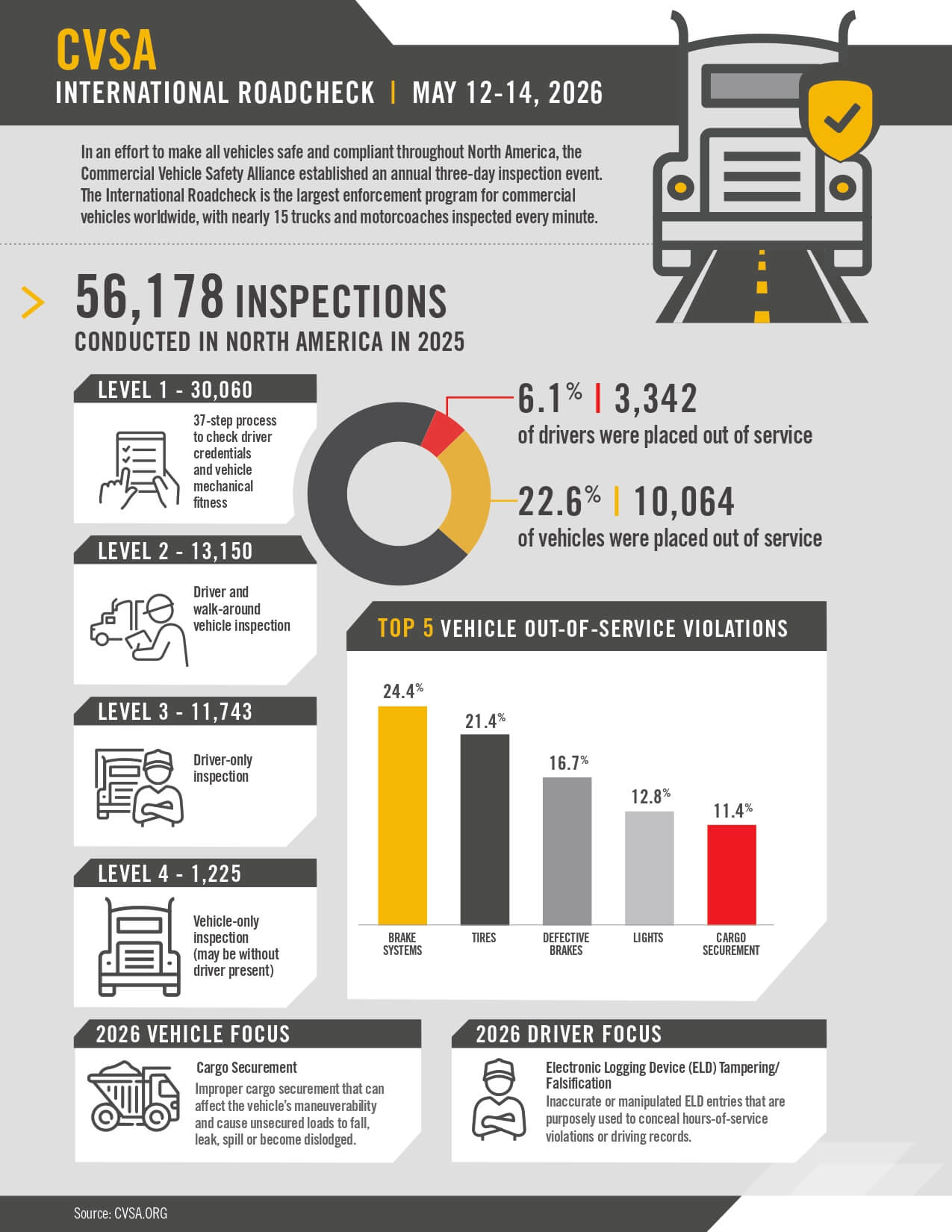
CVSA inspectors conduct a routine North American Standard Level I inspection for most vehicles chosen during the International Roadcheck. However, some vehicles will receive a Level II, III or V inspection. In 2025, more than 50% of International Roadcheck inspections were Level I and 23% were Level II.
- Level I – Standard Inspection. A thorough 37-step inspection that involves checking the driver’s credentials and record-of-duty status (RODS) and the mechanical condition of the vehicle.
- Level II – Walk-Around Driver/Vehicle Inspection. A walk-around driver and vehicle inspection that includes items that can be inspected without physically getting under the vehicle.
- Level III – Driver/Credential Inspection. A driver-only inspection of the driver’s credentials and documentation.
- Level V – Vehicle-Only Inspection. An inspection of each of the vehicle components included in a Level I inspection, without a driver present.
Vehicles that pass a Level I or Level V inspection without any critical vehicle violations will receive a CVSA decal that is valid for three months. Vehicles or drivers found to have one or more critical out-of-service (OOS) violations are removed from service and restricted from operating until all OOS violations are addressed.
2025 International Roadcheck Results
In 2025, 56,178 vehicles were inspected during the CVSA International Roadcheck. Of those inspected, 81.6% of vehicles and 94.1% of drivers did not have any OOS violations and were able to safely continue their routes. However, a total of 17,047 vehicle, driver and hazardous materials/dangerous goods OOS violations were identified as part of the Roadcheck. This resulted in the removal of 10,148 commercial vehicles and 3,342 drivers from the roadways that were found to have at least one OOS violation.
Last year’s International Roadcheck placed a special focus on tires and false records-of-duty status. This resulted in the identification of 2,899 tire-related OOS violations, making tires the second most-cited OOS violation last year after brake systems. Of the 3,317 driver OOS violations found in 2025, 332 (10%) were for false logs/RODS.
Top 5 Vehicle Out-of-Service Violations
- Brake Systems (3,304 OOS Violations, 24.4% of Total)
- Tires (2,899 OOS Violations, 21.4% of Total)
- 20% Defective Brakes (2,257 OOS Violations, 16.7% of Total) – Occurs when 20% or more of the vehicle’s brakes have an out-of-service condition.
- Lights (1,737 OOS Violations, 12.8% of Total)
- Cargo Securement (1,549 OOS Violations, 11.4% of Total)
Top 5 Driver Out-of-Service Violations
- Hours of Service (1,076 OOS Violations, 32.4% of Total)
- No Commercial Driver’s License (810 OOS Violations, 24.4% of Total)
- No Medical Card (493 OOS Violations, 14.9% of Total)
- False Logs/RODS (332 OOS Violations, 10% of Total)
- Suspended License (170 OOS Violations, 5.1% of Total)
Prepare Now for the 2026 CVSA International Roadcheck
This year’s International Roadcheck will take place May 12–14, 2026. To help drivers and fleets identify and address violations before the event, the CVSA has provided cheat sheets outlining what inspectors will be looking for. In general, fleets should take time to complete the following before the Roadcheck:
Vehicle Inspections
- Check brake systems and air lines
- Inspect tires and tread depth
- Verify that all lights and signals are in working order
- Check cargo securement devices for proper number, size and condition
Preventive Maintenance
- Schedule inspections and get caught up on all preventive maintenance
- Address known safety issues
- Review driver inspection procedures
Driver Documentation
- Ensure validity of driver CDLs and medical cards
- Review importance of accurate hours-of-service logs
Review Out-of-Service Criteria
The criteria for vehicle OOS violations are updated each year on April 1, so make sure to review the latest changes and understand what is considered an OOS violation as of 2026 to avoid being taken off the road.
Vehicle Inspection Cheat Sheet Driver Inspection Cheat Sheet
2026 International Roadcheck Focus Areas
This year’s International Roadcheck inspections will place a special focus on cargo securement and electronic logging device (ELD) tampering/falsification.
Vehicle Focus Area: Cargo Securement
Improperly or inadequately secured cargo can adversely affect a vehicle’s maneuverability and increase the likelihood of unsecured items falling off the vehicle, resulting in roadway hazards and/or crashes.
During a CVSA inspection, cargo will be checked to ensure that it is contained, immobilized and secured so it cannot:
- Leak, spill, blow off or fall from the vehicle
- Become dislodged from the vehicle
- Shift to an extent that it affects the vehicle’s balance, stability or maneuverability
Throughout all of 2025, the Federal Motor Carrier Safety Administration (FMCSA) recorded 18,288 violations for cargo not being secured to prevent leaking/spilling/blowing/falling and 16,332 violations for vehicle components or dunnage not being secured.
Follow the cargo securement tips provided by the CVSA to ensure that your cargo is always properly contained.
Driver Focus Area: ELD Tampering, Falsification or Manipulation
Electronic logging devices (ELDs) are pieces of equipment used to automatically record driving time and hours-of-service (HOS) records. They are required by the FMCSA in order to improve road safety and ensure compliance with HOS regulations around driving limits and break time.
During a CVSA inspection, a driver’s record of duty will be checked for false or manipulated entries, with a focus on ELD tampering. ELD tampering/manipulation can take the form of driving while not logged in, disconnecting the device or improperly editing entries. While some inaccurate ELD entries may result from a driver’s lack of understanding of the federal regulations and exemptions, some drivers tamper with them to conceal HOS violations or alter driving time.
If selected for an inspection, drivers must be able to operate their ELDs and transmit records upon request so that the inspector can verify their HOS and the accuracy of their RODS. If any driver OOS violations are identified, the driver will immediately be restricted from operating their vehicle.
Get Your Vehicle International Roadcheck–Ready
Your vehicle can be chosen for an inspection anywhere and at any time, not just during the CVSA's International Roadcheck event. The best way to prepare is to stay on top of preventive maintenance, keep drivers educated about federal regulations and exemptions related to OOS violations, and ensure that drivers have all their necessary paperwork on hand.
If you have not maintained a periodic preventive maintenance schedule for your vehicle, Rush Truck Centers is offering substantial savings on a variety of services through June 30, including DOT inspections, wiper blade replacement, clearance/marker light installation and coolant system inspections, to help prepare fleets and truck owners for the 2026 International Roadcheck.
View our service specials and schedule an appointment today at your local Rush Truck Centers location.
View Service Specials Request an Appointment
COME ALONG FOR THE RIDE. Sign up to receive email updates with our latest promotions, blog posts and news from Rush Truck Centers.