Back To Blog


Key Takeaways
- Axle configuration directly impacts payload capacity, fuel efficiency and traction, making it one of the most important decisions when spec’ing a truck.
- Matching your axle setup and ratio to your load, terrain and route type helps optimize performance while reducing long-term operating costs.
- Choosing between single, tandem or tridem axles depends on your application, with heavier-duty and vocational jobs requiring more axles for stability and compliance.
Choosing the right truck axle configuration directly affects how your truck performs and how efficiently it runs day after day. Whether you’re an owner-operator spec’ing your first truck or managing an entire fleet, getting this setup right can save you money and prevent performance issues down the road. The wrong configuration can limit payload capacity, increase fuel costs or create unnecessary wear.
In this guide, we’ll break down the different types of axles in trucks, explain how axle ratios impact performance and walk through what to consider when choosing the right setup for your operation.
What Is a Truck Axle Configuration?
When you’re spec’ing a new truck, axle configuration is one of the most important decisions you’ll make. It affects how your truck handles weight, performs on the road and complies with regulations.
A truck axle configuration refers to the number of axles, how those axle groups are arranged and how they support the vehicle as it moves forward. Each axle connects a set of wheels and carries part of the truck’s weight, so the configuration directly impacts how that weight is distributed across the vehicle.
In most cases, each axle supports two wheels, though many commercial trucks use dual wheels on each side to handle heavier loads. Because of this, adding or repositioning axles changes how weight is spread across the axles and wheels, which affects traction, stability and tire wear.
Most commercial trucks range from two-axle setups to three or more axles. Each setup is designed for a specific type of job, whether that’s long-haul freight or heavy vocational work.
The Different Types of Truck Axles
There are several types of axles used in commercial trucks. Before choosing a configuration, it helps to understand the role each axle plays.
Drive Axles
Drive axles are powered by the engine and provide traction. They can be located at the rear or, in some configurations, at both the front and rear of the truck.
Depending on the setup, you might have one drive axle or more for added traction. In a tandem setup, two drive axles work together to improve grip and distribute weight more evenly.
Drive axles are critical when hauling heavy loads, driving in poor weather conditions or navigating uneven terrain.
Steering Axles
The steering axle, or front axle, controls direction and helps stabilize the truck. Steering axles are located at the front of the truck and are responsible for guiding the vehicle. Most trucks have one steering axle, but heavier applications could require more.
They typically:
- Carry a portion of the vehicle’s weight
- Handle steering input and directional control
- Influence ride quality and handling
Most trucks have one steering axle, but heavier applications could require more.
Tag Axles
Tag axles are non-driven axles typically located behind the drive axles at the rear of the truck. Unlike drive axles, they do not provide power or traction, but they help support additional weight and improve load distribution.
They typically:
- Carry a portion of the trailer or rear vehicle weight
- Help increase legal payload capacity
- Improve stability on heavily loaded trucks
Tag axles are commonly found on straight trucks and vocational applications where extra support is needed without adding drivetrain complexity.
Pusher Axles
Pusher axles are non-driven axles located in front of the drive axles, typically between the steer axle and the drive axle group. They “push” additional weight onto the drive axles, helping distribute load more evenly across the chassis.
They typically:
- Increase gross vehicle weight capacity
- Help distribute weight across multiple axles for compliance
- Can be fixed or liftable depending on configuration
Pusher axles are often used in heavier vocational or regional haul applications where axle weight limits need to be carefully managed.
Lift Axles (Drop Axles)
Lift axles can be raised or lowered to match load requirements, helping optimize weight distribution and reduce tire wear when they’re not needed. Both tag and pusher axles are often configured as lift axles, making them especially useful in vocational trucks like dump trucks and concrete mixers.
Benefits include:
- Increased legal weight capacity when lowered
- Reduced tire wear when raised and not in use
- Greater flexibility for changing load conditions
Lift axles help operators stay compliant with weight regulations while maintaining efficiency across different loads.
Truck Axle Configurations: Single, Tandem and Tridem Axle Setups
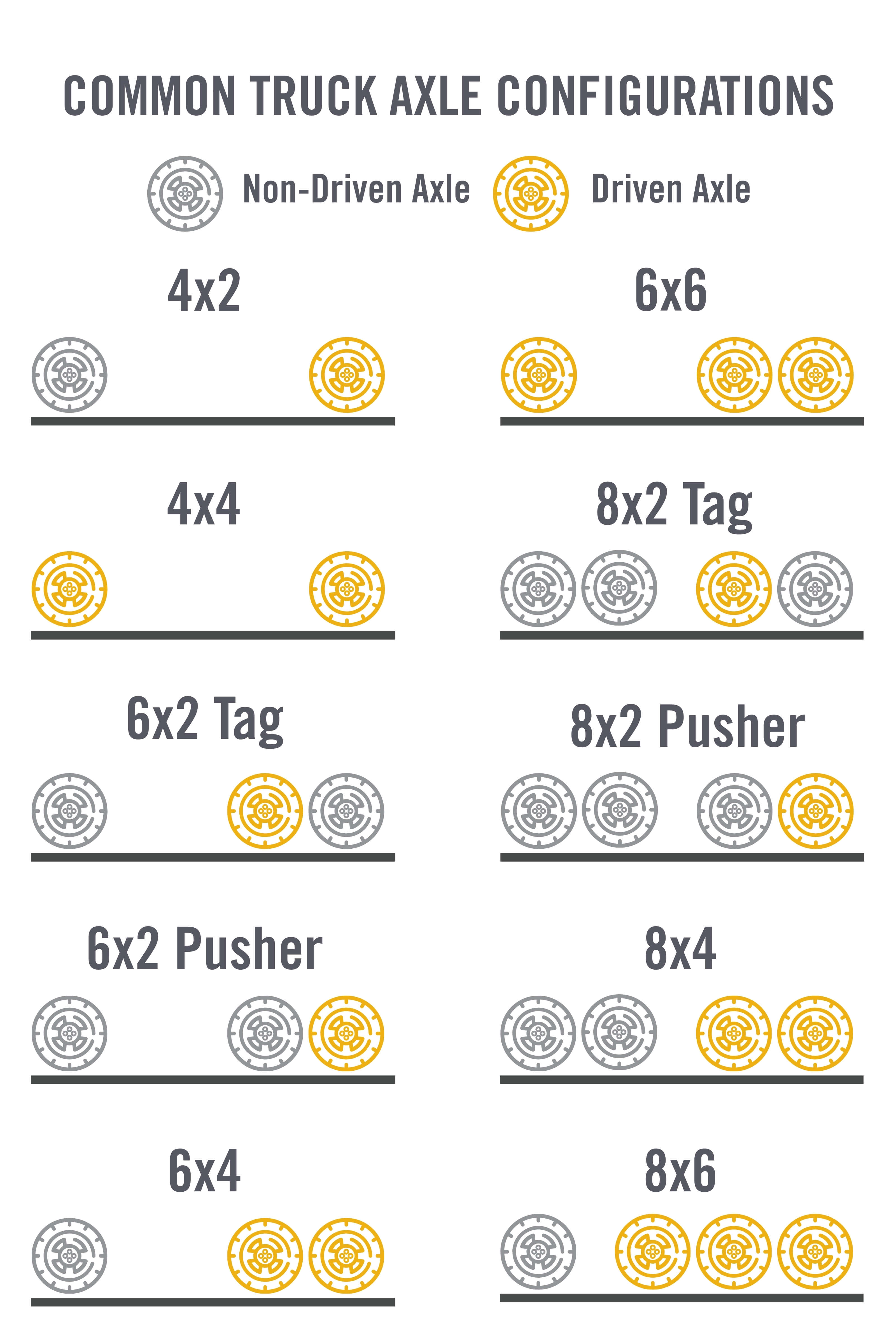
Axle configurations (such as 4x2, 6x4 or 8x6) describe how a truck’s wheels are set up: the first number signifies the total number of wheel positions, while the second number indicates how many of those wheels are driven (powered by the engine). The axle configuration affects how much weight your truck can carry and how it performs under load.
Single Drive Axle Configurations: Single drive axle setups use one powered axle to move the vehicle. They are common in lighter-duty vehicles or regional applications where payload demands are lower and routes are more predictable. This type of configuration helps reduce overall vehicle weight and supports better fuel efficiency.
- Examples: 4x2, 6x2 and 8x2 axle configurations
Tandem Drive Axle Configurations: Tandem configurations use two driven rear axles to distribute weight more evenly and improve traction. In some configurations, such as a 6x2 setup, only one rear axle is driven while the second acts as a non-driven tag or pusher axle to support the load without receiving engine power.
- Examples: 6x4 and 8x4 axle configurations
Tridem Drive Axle Configurations: Tridem configurations use three driven rear axles to maximize load capacity and stability in heavy-duty applications.
- Example: 8x6 axle configuration
You’ll often see tandem and tridem configurations in rigid trucks and vocational vehicles, where higher payloads and durability are essential. Choosing between these setups comes down to your workload — lighter operations benefit from simpler configurations, while heavy-duty jobs require additional support and strength.
How Axle Configurations Impact Truck Performance
Choosing the right truck axle configuration affects more than just weight limits. It also influences fuel efficiency, maneuverability and long-term operating costs.
Different configurations perform better in different environments, so it’s important to match your setup to your application. The right configuration can improve efficiency by reducing unnecessary weight and matching the truck to its route and load.
Here’s a quick comparison of how common configurations stack up:
|
Configuration |
Axle Setup |
Key Benefits |
Trade-Offs |
|
4x2 |
1 Steering + 1 Drive |
Better fuel efficiency, lower upfront cost |
Limited traction and payload |
|
4x4 |
1 Steering + 1 Drive (Both Driven) |
Strong traction, off-road performance |
Higher fuel consumption and lower payload |
|
6x2 |
1 Steering + 1 Drive + 1 Tag or Pusher |
Improved fuel economy, flexible weight distribution |
Less traction in tough conditions |
|
6x4 |
1 Steering + 2 Drive (Tandem) |
Strong traction, higher load capacity |
Increased fuel consumption |
|
6x6 |
1 Steering (Driven) + 2 Drive (Tandem) |
Superior traction, increased payload, improved weight distribution |
Increased fuel consumption and maintenance complexity |
|
8x2 |
2 Steering + 1 Drive + 1 Tag or Pusher |
Improved fuel economy, reduced tire wear |
Limited traction when off-road |
|
8x4 |
2 Steering + 2 Drive (Tandem) |
Higher payload capacity, improved weight distribution and traction |
Reduced maneuverability and increased tire wear |
|
8x6 |
1 Steering + 3 Drive (Tridem) |
Maximum traction, off-road capability, extreme load handling |
High fuel consumption and increased maintenance complexity |
Key Factors to Consider When Spec’ing Your Axle Configuration
Spec’ing a truck isn’t just about picking parts and components. You want to build a vehicle that fits your exact operation. So the axle configuration you choose should align with how your truck will be used every day. Making the right call upfront helps you avoid performance issues and unnecessary costs later on.
Load Weight and Distribution
Start with how much weight your truck will carry and how it will be distributed.
Heavier loads usually require:
- Tandem or tridem setups for proper weight distribution
- Additional lift axles to meet legal limits
- Stronger components to handle repeated stress
Improper load distribution can lead to uneven tire wear and reduced stability, affecting overall vehicle safety and maintenance planning.
Route and Terrain Conditions
Where you drive matters just as much as what you haul. Flat highways favor fuel-efficient configurations like 6x2, while mountainous terrain benefits from 6x4 setups with higher torque. And off-road or jobsite environments require added traction and durability, so they need more drive axles.
Matching your configuration to terrain ensures your truck can handle real-world conditions without added strain.
Fuel Efficiency Goals
Fuel is one of your highest operating costs. Your axle setup plays a direct role in how much you spend at the pump.
To improve efficiency:
- Choose configurations that reduce unnecessary weight
- Pair your axle ratio with your cruising speed
- Consider aerodynamic and rolling resistance factors as part of the full spec
Even small improvements in fuel economy can add up over time, especially for high-mileage operations.
When Different Axle Configurations Make the Most Sense
Not every truck needs the same setup. The right axle configuration depends on your specific application and workload. Understanding when each configuration works best helps you avoid overbuilding or under-spec’ing your truck.
Long-Haul Trucking
For long-haul operations, efficiency is the priority. Most long-haul trucks use:
- 6x4 configurations for reliability and traction
- 6x2 setups for improved fuel economy on consistent routes
These configurations perform well at steady highway speeds and support higher mileage with fewer stops.
Regional and Local Delivery
Regional operations need flexibility. A mix of city driving and highway miles often calls for:
- 4x2 or 6x2 setups for lighter loads
- Balanced axle ratios for stop-and-go conditions
These setups help reduce fuel costs while maintaining enough power for varied routes.
Vocational and Heavy-Duty Applications
Vocational trucks face tougher conditions. Common setups include:
- Tridem configurations for maximum load capacity
- Lift axles to adapt to changing payloads
- Higher axle ratios for better torque and control
These configurations are built for demanding environments like construction sites, where durability and strength matter most.
Find the Right Truck at Rush Truck Centers
Selecting the right truck axle configuration truly comes down to understanding how your truck will be used every day. From axle types and their configuration to terrain and load demands, each choice plays a role in performance and efficiency. When everything is aligned, your truck works harder for you without adding unnecessary costs or complications.
We’re here to help you get that balance right. Our knowledgeable truck sales experts at Rush Truck Centers are ready to help you spec the right axle configuration and components for your exact application. With access to a large inventory of new and used trucks across multiple brands and configurations, we can help you find the right fit for your business.
Search our inventory or contact us today to start spec’ing the perfect truck for your application.
Search Inventory Inquire About a Truck
COME ALONG FOR THE RIDE. Sign up to receive email updates with our latest promotions, blog posts and news from Rush Truck Centers.